

I can’t wait to talk to my Humble & Fred pals Howard Glassman and Fred Patterson (next visit: January 20) about “CFNY: The Spirit of Radio.” The documentary, from Highball TV, recently premiered on TVO and can be streamed on TVO’s digital platforms, including right here on YouTube.
The film is credited to Matt Schichter as director, although, according to Toronto Mike, it sat on the shelf for a year while tinkering took place. What survives takes a nostalgic look back at a radio station on the periphery of the Greater Toronto Area. It was cherished by listeners seeking alternative and new wave music, including punk bands from the UK such as the The Sex Pistols and The Clash, but also a vital new homegrown indie sound. This wasn’t your parents station (my dad practically had our radio dial nailed to CFRB), or even the Top-40 Toronto stations such as CHUM or CFRB and later CHUM-FM.
CFNY deserves some sort of retrospective. If you were a listener, it seemed very much of its time, very “inmates running the asylum,” hippies doing it to The Man kind of place. It was sort of WKRP in Cincinnati meets those “Pirate Radio” documentaries covering off-shore operations in The UK, America and New Zealand.
Instead of a boat, however, CFNY launched in 1976 out of a ramshackle yellow farmhouse where records sometimes skipped when mice hopped on the turntables. The signal reached well over several blocks around Brampton.
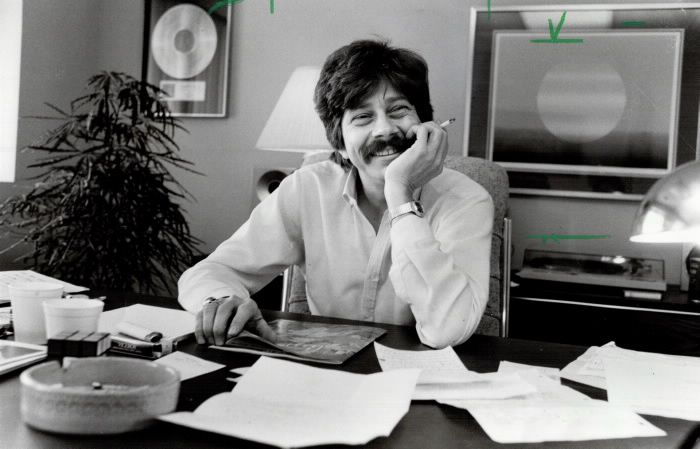
Dave Marsden, who quickly emerges as one of the main voices on the documentary, is among those describing the farmhouse as a filthy mess. When he arrived at ‘NY, he was already a renowned DJ after stints in the ’60s and ’70s in Toronto and Montreal under the handle “Dave Mickie.” Later, as CFNY’s program manager, he was recognized as the vision guy, opening doors wide to indie bands and acts not heard on other stations, and giving jobs to an eclectic gang of rebel DJs. Marsden, we learn, came up with the slogan, “Spirit of the radio.”
The producers, including CFNY veterans Alan Cross and Ivar Hamilton, are among this documentary’s most verbose talking heads. The filmmakers do an impressive job of rounding up cameos from several members of the bands featured on ‘NY, including Geddy Lee from Rush, who confirms ‘NY was the inspiration behind their own “spirit of the radio” song reference. Also featured are Peter Hook of Joy Division, Richard Barbierie of Japan, Steve Diggle of Buzzcocks, Deryck Whibly of Sum 41, and Lol Tollhurt of The Cure. They all credit ‘NY with playing records no other station would touch, and were thrilled that these DJs actually seemed to dig their music.
advertisement
Steven Page, formerly with Barenaked Ladies, credits the station with “changing the way I listened to music.” He was grateful to find a station where the music he loved was all in one place, even though that spirit died before the Ladies had a chance to move in.
CFNY grew, bouncing signals off an illegal tower before eventually scoring a key perch atop the CN Tower. By the ’80s it was housed in a second story office above a strip mall on Kennedy Road in Brampton. Back when I worked at TV Guide in the ’80s, I remember going there once, probably to blab about the upcoming TV season, and being surprised that these rebels were crammed in a cedar-shingled mon-and-pop mall across from The Brick. It seemed far from Toronto in so many ways; little did I know I’d move and spend 25 years in that city.
Here is what I don’t like about the doc. While many key voices are assembled, there is a relentless parade of them. Clips are too short and come one after another, with not even enough time to read the captions off the screen (although I did like the few “Pop Up Video” bubbles.)
Getting back to Humble & Fred, it was great to see Freddy sharing one or two smart insights, but glimpsed next to him, unheard, was one of the great storytellers in radio, “Humble” Howard Glassman. How do you leave him out?
Fewer voices, allowed to tell an actual story or two instead of brief soundbites, would have added some pace to this documentary, which at times seems as if all the interviews were thrown into a blender.
The film also seems to run out of time. As the station got hammered by changes in ownership, declining ad sales and changes in musical tastes, the spirit of radio was crushed. Fans became apoplectic when pop stars such as George Michael were played. (“Hey, don’t pick on George Michael” sez Sandra here.)
We learn that there was one last, beautiful, rebellion, a revolt by listeners against the blandness of a Top 40 hybrid imposed by the new suits in charge. It was back to new wave, then a stark title reveals the dreaded Top 40 makeover happened again anyway. Alas, it was too late to save the station. By the early ’90s, CFNY was done, eventually evolving into 102.1 The Edge.
That last minute or two seemed like the summary of a next chapter. Too bad we didn’t get to see or hear it, but kudos to TVO Docs for showing what did get made. CFNY was a unique story and particularly cherished by fans in or now approaching their sixties.
In a way, it works to see CFNY celebrated in what plays at times as a rough cut. Good on the provincial public broadcaster for spreading the spirit, and offering glimpse into what rebellion sounded like in the innocent time before the Internet.

1 Comment
A lot of good bits but I cannot believe they had no actual on-air recordings. I also think they missed talking more about the connection to local music and the CASBYs were never mentioned at all.