

While it probably helps, you don’t have to be a fan of anything Disney to be astounded by the new documentary Disneyland Handcrafted. You do, however, have to subscribe to Disney+ or have access to YouTube. The full documentary is available now on both platforms.
The project is culled from a treasure trove of well-preserved, 16mm film footage originally shot for Walt Disney’s weekly TV shows Disneyland and The Wonderful World of Disney. Director Leslie Iwerks certainly has the pedigree for the job. Her father, innovative film technician Don Iwerks and grandfather Ub Iwerks were both Disney legends (Ub, among many other things, co-created, designed and animated Mickey Mouse.)
Leslie has established herself as a talented documentartian with an impressive track record. One of her short films, Downstream (2008), looked at the harm caused by chemicals leaking into native communities as a result of the Alberta oil sands digs. Other projects include documentaries about Pixar, Industrial Light and Magic and Guatemala (the latter, “Recycled Life,” was nominated for an Academy award).
While producing and directing an earlier documentary on Walt Disney Imagineering in 2013, Iwerks came upon an incredible find: buried in the studio vaults were several reels of 16mm film chronicling the construction of Disneyland. Walt Disney was savvy enough to hire a crew to capture the creation of his ambitious pet project, which took place over 160 acres of what were once orange groves in Anaheim, Ca.
Walt borrowed much of the $17 million mid-’50s dollars to build the park. He needed admission revenues to pay the banks back and set a ridiculous construction deadline: one year. The documentary records how it somehow came together in a year and a day, from July 1954 to July of 1955.
That wasn’t all that was sped up. Much of the footage discovered by Iwerks was shot in time lapse photography from cameras mounted on towers around the property. Disney was a smart man, and had learned a thing or two shooting real wildlife adventures around this same time.
advertisement
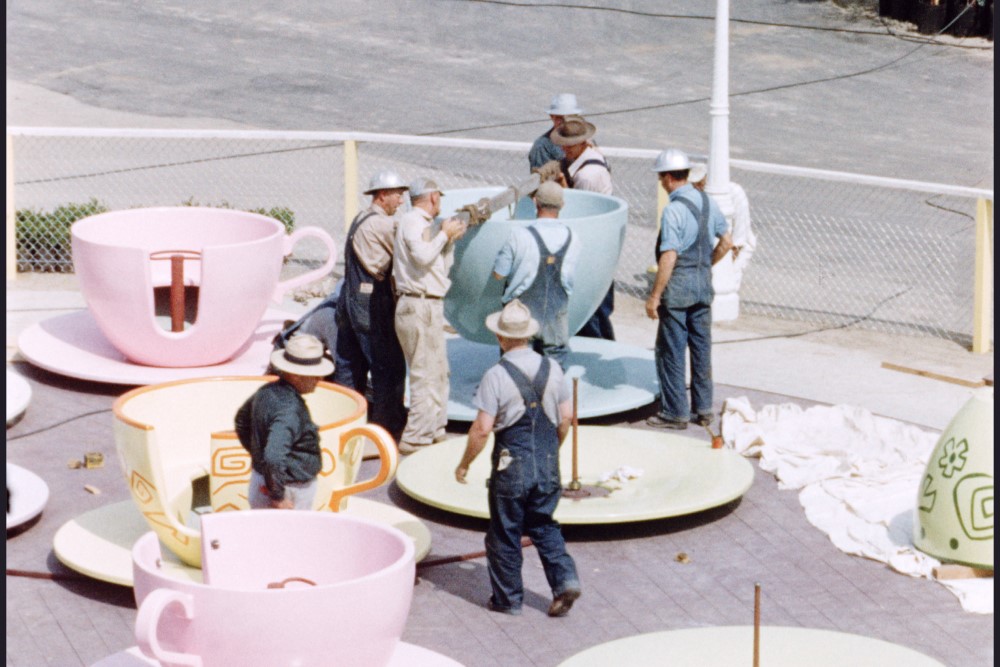
We’ve seen glimpses of this footage before, on Disney shows and Iwerks’ earlier docs, but never to this extent. Also shot and just as valuable were on-the-ground footage of everything else being shot in real time: the dredging of the Jungle Cruise swamps, the construction of Disney’s large, turn-of-the-20th Century main street, the magic castle, Adventureland, Frontierland and Tomorrowland (the one theme area which was not operational on opening day).
Just building a giant berm around the theme park and parking lot, as well as the railroad track that circles it all, might take a year today. Disney demanded not just that, but construction, from scratch, of the actual steam locomotives and passenger cars that road the tracks; the 105-foot, paddle wheel riverboat the Mark Twain; an impressive pirate ship; all the cars on the Autopia attraction (which originally motored freely as go-karts) — even all the spinning tea cups.
Little known fact: Disneyland’s oldest attraction once spun in Canada. The merry-go-round was a fixture in Toronto’s Sunnyside area until the construction of the Gardiner Expressway demolished that cherished amusement park in the ’50s. Disney rescued the ride and shipped it south.
Critics and almost everyone else dismissed the construction of Disneyland as “Disney’s folly.” The filmmaker behind such hits as “Snow White and the Seven Dwarfs” and “Fantasia” had gone in debt and risked everything before, but this scheme could have sunk the studio, as his brother and financial partner Roy Disney kept reminding him. Disney’s only use for money, however, seemed to be what it could build for him.
This making of doc, therefore, is a compelling story. Along with the film images, Iwerks was able to make good use of the many audio interviews archived for decades, allowing us to hear from many of the people who were knee deep in the mud and hot sun. There is no narration or cutaways to the few who survive or anyone connected to Disneyland today. It is simply an unbroken account, told in archival footage, from start to finish.
The film ends with a hectic, somewhat chaotic look, on film and restored kinescopes, at opening day, July 17, 1955. ABC, which aired Disney’s early TV series and put up some of the millions needed to build the park, captured it all on a live special with Art Linkletter, Bob Cummings and future American president Ronald Reagan acting as hosts.
Linkletter, born in Moose Jaw, Saskatchewan, and a popular daytime TV host in the ’50s and ’60s, provides several eye witness accounts. They include his perspective when Disney himself drove him the hour or so down from Los Angeles to show off the early stages of the project. There he saw nothing but bulldozed land and a few trees being planted. “I didn’t dare tell Walt I thought he was crazy.”
That opening day found the asphalt paving so fresh in the hot sun that high heels were sinking in everywhere. So many people, primed by what amounted to a weekly infomercial on ABC leading up to the opening, surged the grounds. The mob could barely walk up main street. A plumbing strike had forced Disney to choose between offering visitors washrooms or drinking fountains. Walt reasoned they could drink Coke or Pepsi but could not be permitted to pee in the street.
Working the park were the first generation versions of Mickey, Minnie, Donald and Pluto, and all the other Disney characters. Back then they looked like they were wearing costumes you could find in a party store today. Marching bands were unable to rehearse as ABC camera crews and still-at-it construction crews clogged up the main arteries. They still somehow managed to hit their marks and put on a show. So did one of the big early attractions, the young members of the Mickey Mouse Club. with Annette and Bobby and Cubby the K-pop superstars of early television.
Since that opening day, 900 million people have visited “the happiest place on Earth.” The world being a more ruptured Frontierland, fewer Canadians are going now. Still, everyone can see how it all started in this sweet and nostalgic little time capsule of a movie.



2 Comments
This really is a time capsule. The restored 16mm footage and the “start-to-finish” archival storytelling are absolutely mesmerizing—highly recommended even if you’re not a Disney superfan
This sounds absolutely fascinating! I’m not even the biggest Disney fan, but the idea of seeing all that 16mm time-lapse footage of Disneyland being built in just a year and a