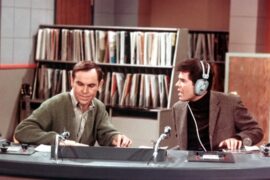


A true tastemaker and a real gentleman, legendary late night executive producer Peter Lassally died July 19 in Los Angeles. He was 93.
Back in 2008, I had the great pleasure of interviewing Mr. Lassally as he was winding up his extraordinary career in late night with his final stint as executive producer of The Late, Late Show with Craig Ferguson. With thanks to producer Michael Naidus, the interview took place in Lassally’s office at CBS Television City in Hollywood.
For close to an hour, Lasally thoughtfully answered questions, went off the record for a few, and regaled me with stories about Johnny Carson, David Letterman, Ferguson and many others. In listening back to the conversation — for the first time in 18 years — I’m struck not just by his professionalism but also by how generous and candid he was on that day. He seemed to have Johnny Carson’s gift for making the guest look good and feel at home.
At the time I was compiling interviews for a book I planned to write about the history of late night television. I never wrote that book, but getting to speak with Lassally was certainly a high point in that endeavour.
Lassally’s back story is remarkable. Born in Germany to Jewish parents, he was a holocaust survivor who went to grade school with Anne Frank. His family fled to the Netherlands in 1938. There, he, his sister and their mother were interned at the Westerbork concentration camp. They were spared when the war ended and they were never transferred to the horrors of the deadlier camps.
After the war the family immigrated to New York. Lassally became a page at NBC where he quickly rose through the ranks. His producing roots date back to radio days when he was assigned to Arthur Godfrey. One of the most popular broadcasters of his time, Godfrey was by all accounts a complicated personality who could be charming one moment and then fire a singer live on the air the next. For Lassally, working with Godfrey had to have been a baptism by fire for how to deal with the top stars in late night television.
advertisement
Starting in 1969 in New York, Lassally was an executive producer of The Tonight Show starring Johnny Carson. He later went on to executive produce shows for both David Letterman and then came out of retirement to do it all again for Craig Ferguson.
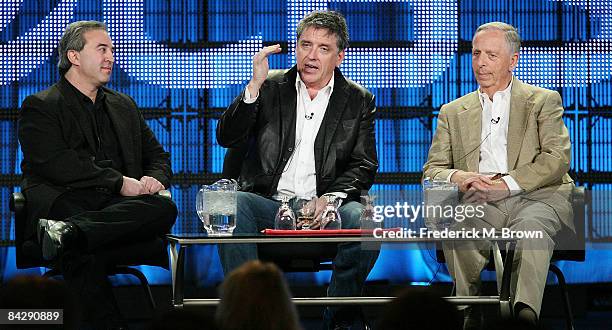
Lassally gained a reputation as the “Host Whisperer.” A dapper, soft-spoken man, he knew what to look for in a host or a guest, or even a guest host.
Number One for Lassally was likability.
“That’s true for guests, and that’s true for our hosts,” he told me. “They have to be likable so that you care about them.” He recognized early that Ferguson — an otherwise hard sell to the network at the time due to his Scottish accent — had that quality. “He’s charming. He’s funny. He has wonderful, original thoughts and ideas but none of that would work if he wasn’t likable.”
Number Two for Lassally was sustainability. Back when Carson took one day off every week, the executive producer thought he had found a “unique” new guest host in former M*A*S*H star McLean Stevenson.
He was an original,” thought Lassally at first, “And then, after a few appearances, you could see the same things popping up. Which means a small bag of tricks. You know, the same expressions, the same reactions. So how well will a guest wears on people, I think, is Number Two.”
Other qualities included good comedy instincts; knowing when to follow up with a question; and not going too far or making it “pushy.”
I challenged him a bit on his host “must haves” when it came to David Letterman. He was smart but sometimes, especially at the beginning of his talk show career, smart-ass. I would never tire of him, I told Lassally, but it did seem some guests were afraid to do his show, that he would, and Lassally knew where I was going, “eat them alive.”
Lassally though that rep was unfair. “I never felt he was hard on his guests,” he said. “He could make a guest look good, which he learned from Johnny. Dave followed that.”
When it came to Ferguson, Lassally’s immediate take was that the comedian had incredible range. “He is really intelligent. Extremely well read. He listens to the guest more than anyone else. And because he listens so well he will take some comment they make and run with them and go into completely different directions.”
He also learned that Ferguson was at his best when he wasn’t scripted. Out went the traditional monologue. Off went the tie. Blue question cards were torn up for each guest and thrown through a fake window.
A turning point came on the first show Ferguson hosted after the death of Carson.
“That was a big change because I always told him from day one, I told him what I was looking for was intimacy – intimacy between the host and one viewer out there. Talk into the camera, don’t talk to the studio audience. Talk to one viewer and make it as intimate as you can.”
Carson died at 79 in January of 2005 — less than three weeks into Ferguson’s run on The Late, Late Show. Lassally knew that Ferguson had never met Carson, so he asked him to begin that night’s show by talking about what Carson meant to him as a viewer.
“And he told a very moving story about how overwhelming this country was and how it was all a bit frightening to him when he first came here and then Johnny Carson made it all like it was just a small village. And I don’t remember how long that ran but probably was five or six minutes and it was right from the heart. And at the end of the show I said, that’s what I want you to do every night.
Lassally blew my mind when I asked him if there was a common thread to Carson, Letterman and Ferguson. They weren’t all from the mid-west — a trait linking Jack Paar, who grew up in Michigan, with Carson and Letterman — unless Ferguson was from the mid-west of Scotland. (He wasn’t.)
Lassally did not hesitate with his answer.
“They have one thread — they all have mothers that didn’t give them enough love.”
“Really?” I said, surprised. Lassally said this to others since, but at the time I heard it, it was a revelation.
It’s fairly well known by now that Carson’s mother was very stingy when it came to praise for her son. The stories in lawyer Henry “Bombastic” Bushkin’s book, Johnny Carson, are of a cold-hearted woman with the King of Late Night only finding out after his mother Ruth died that she kept a scrap book full of Tonight Show clippings. On news of her passing, Carson reportedly quipped, “The wicked witch is dead.” He even skipped her funeral.
But sweet little Ma Letterman? That little white-haired lady? As I said to Lassally, “I have her cookbook!”
“Yep,” said Lassally. “Comes off as the most darling mother you could imagine.”
“And these guys,,,” I started, “…are still looking for approval.” said Lassally.
Mike drop.
We went on to talk about Jay Leno, and Conan O’Brien and even then new upstart Jimmy Kimmel, whom Lassally admired. They all, he felt, had their strengths.
He even stood behind late night pioneer Steve Allen’s glib assertion that you could put a monkey behind a desk on late night and he would get the same rating.
“I think that’s true,” said Lassally, who referenced the success of the chimpanzie J. Fred Muggs who “co-hosted” The Today Show back in the mid-’50s. “I would tune in and see what he does tonight, right?”
Letterman used to joke that “they don’t give these shows to chimps,” but perhaps they will, soon, if the downward trend in ratings and upwards trend in costs continue to raise concerns about the current fate of the genre.
A chimp might succeed if it had Lassally there to advise. The executive producer shared his knowledge and memories and honest opinions for nearly an hour, and only occasionally asked that a negative comment be kept off the record. Even that was a plus, in that he let a reporter know where he really stood, and had the confidence that his wishes to not share everything be respected.
Lassally knew what to tell Carson, Letterman and Ferguson about what it took to talk to guests because he basically told them to do what he did — tell great stories, but let others shine and make the guest feel at home and welcome. Lassally knew first hand that likability was the key. What an unforgettable pleasure it was meeting him.
This coming Monday on brioux.tv: the podcast — hear these stories and more from Lassally himself as edited portions of our conversation with be the next episode “From the Vault.”