


For any of us who covered Charlie Sheen’s dark “Tiger Blood” days (2010-11), the prospect of re-living it can seem anything but “winning.” As the former Two and a Half Men star himself says towards the end of the two-part, three hour Netflix documentary aka Charlie Sheen, the whole world these days is a bit of “un unflushed toilet,” Do we really want to revisit the scene of this crime?
First, some reasons to watch. Despite ingesting, for way too many years, a copious amount of cocaine, booze and other drugs, Sheen at 60 looks pretty good. We share a booth with him (and director Andrew Renzi) at a diner throughout the doc, a setting Sheen likes because you generally know what you are going to get in a diner,
We hear from others throughout the two-part feature, including Chuck Lorre, the executive producer who had to steer one of TV’s biggest hits around a star who seemed on the verge of self-destructing, and the other “Man” on that series Jon Cryer. (Half Man Angus T. Jones did not participate). Lorre and Sheen were once locked in a legal battle after Sheen was fired from the series and later sought compensation for his dismissal (a settlement was reached).
Writer-producer Lorre, who went on to sitcom success after success, shows no bitterness and actually some remorse. On Men, Sheen won a contract extension reported at $2 million per episode at a time when the series probably should have been shut down and the star banished to rehab.
Cryer, on the other hand, still seems pretty upset. This despite the fact he enjoyed a 12-season run on Two and a Half Men, sticking with the sitcom four extra seasons after Ashton Kutcher came aboard to stretch out the run of the series post-Sheen.
Another testimonial comes from childhood pal Sean Penn, who testifies that unsinkable Sheen must have a different structural biology than the rest of us. He certainly has a different one than Penn, who seems to be testing his own limits with cigarettes. Ex-wife Denise Richards gets teary at times, is quite candid on the reasons behind their breakup and, despite everything, still seems to love the big lug. Another ex-, Brook Mueller, says never mind Charlie — she can’t believe she didn’t overdose from all the drugs she consumed trying to keep up with her husband.
advertisement
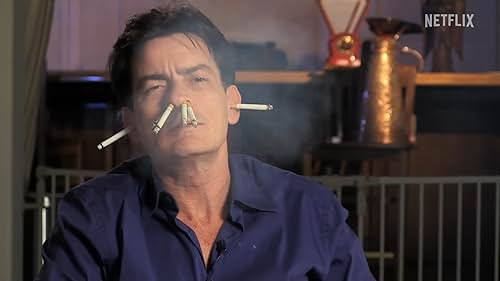
Speaking of which: a drug dealer friend, Marco Abeta, emerges as a bad guy-good guy in this yarn. Did he save Sheen’s life by secretly weening him off crack? Movie co-star Chris Tucker nervously stands up for Charlie. Notorious Hollywood Madam Heidi Fleiss, who looks more tired than Madeline Kahn in “Blazzing Saddles,” appears surrounded by various exotic birds. Fleiss seems a pretty good sport considering how she basically did time in prison to protect the Hollywood nepobaby.
Neither dad Martin Sheen nor brother Emilio Estavez agreed to any on-camera interviews, although there is plenty of retro clips where dad tries to rescue his wayward lad, to the point of even having him arrested. Charlie’s big brother Ramon Estevez does rep the family here and there.
Also not heard from were some of Sheen’s other pals from their hell-raising, Hollywood brat pack days, including Kiefer Sutherland, Rob Lowe and Danny Bonaduce.
The reasons to watch really come down to Sheen himself. Netflix is promoting the project this way: “With seven hard-fought years of sobriety behind him, Charlie Sheen – as you’ve never seen him – finally leaves it all on the table, and revisits the very public peaks and valleys of his life with humour, heart and jaw-dropping candour.”
Sheen does appear to be in a confessional mood. Much is made of his never-before-told admission that in the worst days of his drug-fueled debachery his sexual hijinx extended to liasons with other men, perhaps even two and a half men. Sheen insists that was not how he became infected with the HIV virus, insisting that he was actually relieved to get the diagnosis. His fear was that his deteriorating health at the time was due to something much more fatal.
It took never shy Bill Maher to, probe a little deeper. On last Friday’s Real Time, the host bluntly asked Sheen if he was on the top or the bottom. Sheen said it never got that far, leaving viewers to draw their own conclusions.
After these revelations, the documentary tried for a quick dash towards the redemption finish line. We see Sheen responding to a daughter’s call for help and other evidence, with Lola Rose Sheen and son Bob Sheen insisting their old man is now a good, reliable dad.
May it be so, but the slog through Sheen’s worst days when he pretty much was a one-man TMZ magnet begins to grind about halfway through the second episode. There is a sloppiness to some of the storytelling. I recognized a TCA colleague in one brief clip but she is never identified. The hand-printed titles seemed more cost-efficient than creative.
These points are nitpicking, but whether or not you buy aka Charlie Sheen as a tale of redemption, it should never drag. I remember how electric it was to even be on the fringes of Sheen’s shenanigans. On Los Angeles press tours, reporters would hound CBS entertainment president Nina Tassler at executive sessions asking if Sheen would be fired. O the backpeddling to protect one of television’s most lucrative programming baubles.
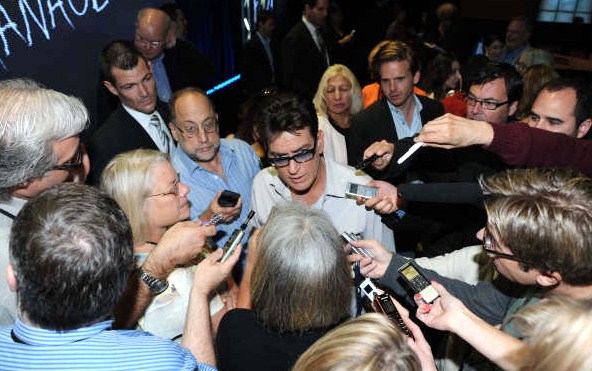
FX held one sneaky session in January of 2012 to promote the series quickly conjured to pay some of Sheen’s post-meltdown bills: Anger Management. I vividly remember one dark night at a frequently used off-campus venue — the suitably creepy Castle Green apartments in Pasadena, Ca. FX PR boss John Solberg gave a few of us the triple top secret password and led us behind the building to a dark corner of the back lawn. There was Sheen sitting at a patio table, with Bruce Helford, executive producer of Anger Management, on his right with a huge lug of a security guard standing directly behind both men.
Kiefer Sutherland, at the Fox deal to promote his upcoming series Touch, snuck back to give Charlie a hug. As reporters moved in, Sheen calmly and reasonably stick handled around 12 months of bizarre, warlock mis-behaviour. In many ways, it was the most sober press conference at TCA.
On a more relaxed prior occasion, Sheen raved to me about the Toronto Blue Jays. He talked about staying at the Skydome hotel during a film shoot in T.O. just to gaze out at a team he admired.
I have seen up close this side of Sheen that makes him somebody to root for and you will feel that pull in moments watching aka Charlie Sheen. Early in Part one of this feature, the story behind Sheen’s first big break, a one-day shoot that truly was winning on “Ferris Beuler’s Day Off,” is a prime example. Overall, however, this is a film about the time the highest-paid actor on television tried to throw it all away. It seems ill-timed, arriving, as Sheen says, right when the whole world seems to be circling the bowl. And that is a whole other level of sobering.