
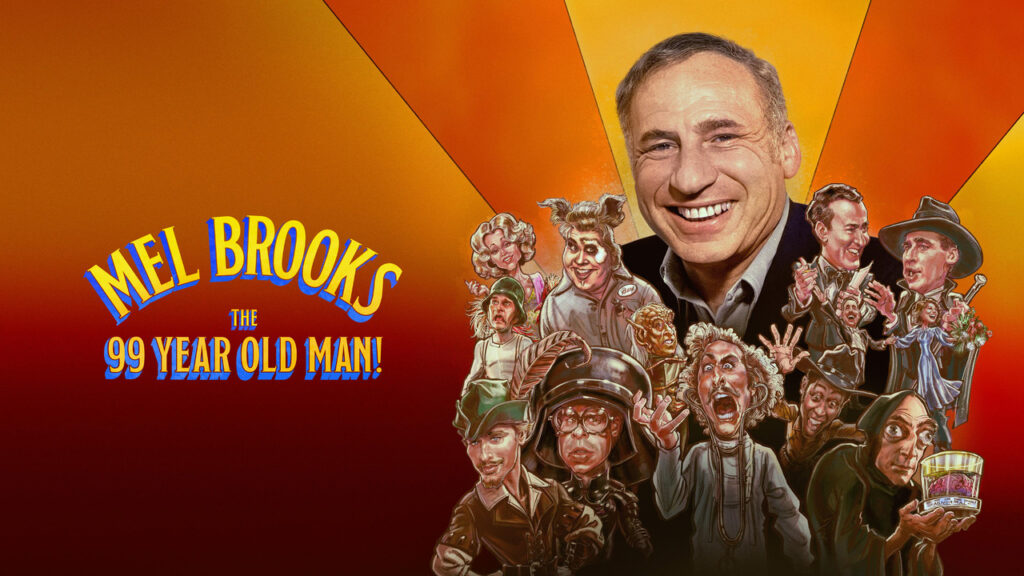
This week on CBC Radio stations across the country, I was asked to comment on “Mel Brooks: The 99 Year Old Man!” The two-part documentary, directed by Judd Apatow and Michael Bonfiglio, premieres this Thursday and Friday on HBOMax and Crave.
Each regional radio host started by asking me to explain who Brooks is for listeners who may not have heard of him. This seems impossible to me. As Apatow says (and he makes a compelling case with this film), Brooks is the funniest man who ever lived.
Fact is, Brooks is one of the architects of modern comedy, He directed “Blazing Saddles” and “Young Frankenstein” in the same year (1974); co-created, with Buck Henry, the sitcom spy spoof Get Smart!; wrote for one of the most brilliant sketch shows ever, You Show of Shows; and recorded one of the funniest comedy albums with Carl Reiner, “The Two Thousand Year Old Man.”
Consider all those Tony Awards Brooks won for turning his 1968 film “The Producers” into a Broadway smash. That happened 25 years ago in 2001. Then there were all of those late night talk show appearances. Brooks was wild and spontaneous on Johnny Carson’s first Tonight Show in 1962 right up to one of his last appearances 30 years later in 1992.
Just the same, not everybody born in this century knows Mel Brooks. Apatow, however, who interviewed the comedy legend for 10 hours at his house for this documentary, does his best to place him on the Mount Rushmore of mirth. He has help, with commentary from many who were inspired by Brooks to get into the comedy business. Appearing are Conan O’Brien, Adam Sandler, Nick Kroll, Amy Schumer, Jerry Seinfeld, Sarah Silverman, Patton Oswalt, Dave Chappelle and Ben Stiller,
Apatow is becoming the Ken Burns of 20th century comedians (look up his previous documentaries on Garry Shandling and George Carlin, with more pending on Maria Bamford and Norm MacDonald). As both director and interviewer, he frames this story with an important question: even if you know Mel Brooks, do people realy know who he is?
advertisement
“No,” says Brooks, setting the tone for this Two-Part biography.
We learn of his hardscrabble life growing up in Brooklyn. His father died of tuberculosis when Brooks was very young. Brooks mother, Katie, who gave birth to him on the family’s kitchen table, raised four boys on her own. All four, including young Mel, served in World War II. Brooks recalls dodging instant death by jabbing a Bayonet into the ground while in France, looking for booby traps left behind by the retreating German army.
The experience helped develop within Brooks a lifelong determination to stand up to bullies, be they of the schoolyard variety or fascist dictators. He famously lampooned der fuhrer in “Springtime for Hitler,” the play that was built to bomb in “The Producers.”
Brooks’ own comic inspiration came to him at the movies. Silent clowns such as Buster Keaton and Charlie Chaplin were favourites. Brooks “Silent Movie” (1976) paid tribute albeit in colour instead of black and white and starring Burt Reynolds, Dom DeLuise and Marty Feldman. The one word spoken in the film was by famed mime Marcel Marceau.
The Marx Brothers inspired Brooks, as did the all but forgotten Ritz Brothers. Still a teen, he found a job in the Borscht Belt — dens of comedy in the Catskills north of New York City. There, Burlesque comics, mainly Jewish, thrived. Brooks found his way on stage and out of a more likely fate — working in the garment district.
The documentary allows Brooks to tell much of his own story. We learn that after the war he used his “special services” army connections to find work in New York. He first saw Sid Caesar in 1947 and was knocked out by his characterizations. “If there was no Sid Caesar, there would never have been a Mel Brooks,” he declares.
Brooks eventually followed Caesar to the live, 90-minute sketch series Your Show of Shows (1950-54). Do the names Neil Simon, Mel Tolken, Larry Gelbart, Lucille Gallen and Carl Reiner mean anything? Just the greatest TV writing room ever. Brooks, who was paid directly by Caesar, was known as “the living interruption” by one of the other writers.
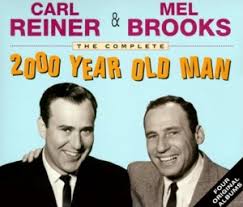
The documentary tells us that a comedian’s life isn’t always funny. Brooks had his own problems with high anxiety, which he worked out through psychoanalysis. There were lean years financially after the Sid Caesar shows ended. It wasn’t until the “Two Thousand Year Old Man” that he broke through to stardom as a comedian. The sketch began as a bit Brooks used to do at parties with Reiner. It became a hit album in 1960, and then a series of albums. Dave Chappelle calls it the funniest thing ever.
Meeting Anne Bancroft was his next lucky break. Brooks had been married before, to dancer Florence Baum. They had three children; a fourth, Max, an occasional guest on Real Time with Bill Maher, was born to Brooks and Bancroft. Those parents, as Reiner says in one clip, seemed like an odd couple to many, but her arrival in his Mel’s life seemed to open the door to greater things.
Brooks boasts a showbix EGOT, winning an Emmy, Grammy, Oscar and several Tonys. At times in Part I he seems to have an ego to match the EGOT. A black and white clip from The Mike Douglas Show finds Brooks taking over the show, interrupting Dr. Joyce Brothers and generally being a pain in the ass. A funny jerk, sure, but a jerk.
Comedy films seldom win Oscars. Brooks picked his up early in his directing career for writing the screenplay for “The Producers.” That cleared the way for him to go for laughs rather than laurels with his great comedies, “Blazing Saddles” and “Young Frankenstein.” The films that followed, including “Silent Movie,” “High Anxiety,” “Men in Tights,” “History of the World Part I” and “Spaceballs,” all had their moments. Brooks was at his best when he stuck to his guiding principle: make it funny, and don’t be afraid to be silly or sophisticated.
Example: “Blazing Saddles.” Any other comedy which repeated the “N” word that often would have been ridden out of town. With Richard Pryor egging him on as a writer, Brooks somehow hung his whole movie on the ridiculousness of racism.
“Spaceballs,” on the other hand, is nothing but groaners. Try not to laugh, however, at Rick Moranis’ Big Helmet. Or at Brooks himself, from his 1983 remake of “To Be or Not to Be.” Dressed as Hitler, he danced around singing, “I want Peace! A little piece of Poland, a little piece of France…” That the satire scores harder today is proof that we need Mel Brooks more now than ever.
Part 2 of the doc is quite moving at times as Brooks deals with the loss of his wife Bancroft at 73 in 2005 and the death of best friend Reiner at 98 in 2020. Clips from Jerry Seinfeld’s visit to Reiner’s house on Comedians in Cars Getting Coffee are shown. The sweetness of that relationship, two comedy legends, eating deli sandwiches on trays while watching Jeopardy!, is, as Seinfeld says, as good as it gets. That Carl’s son Rob Reiner, in his last interview, is the one providing the commentary on that ritual is beautiful and very sad all at once.
If you still don’t know the man, consider this amazing thing he once said: “Comedy blows the dust off your soul.” Brooks understood and mastered the healing power of laughter. He knew it could pick you up when you are down. He blazed a comedy trail that has echos to this day on The Simpsons, Family Guy, South Park or SNL.
By the end of “Mel Brooks: the 99 Year Old Man,” you will know him and be grateful that he has this gift to be funny. The documentary can be streamed on demand on HBOMax and Crave.