
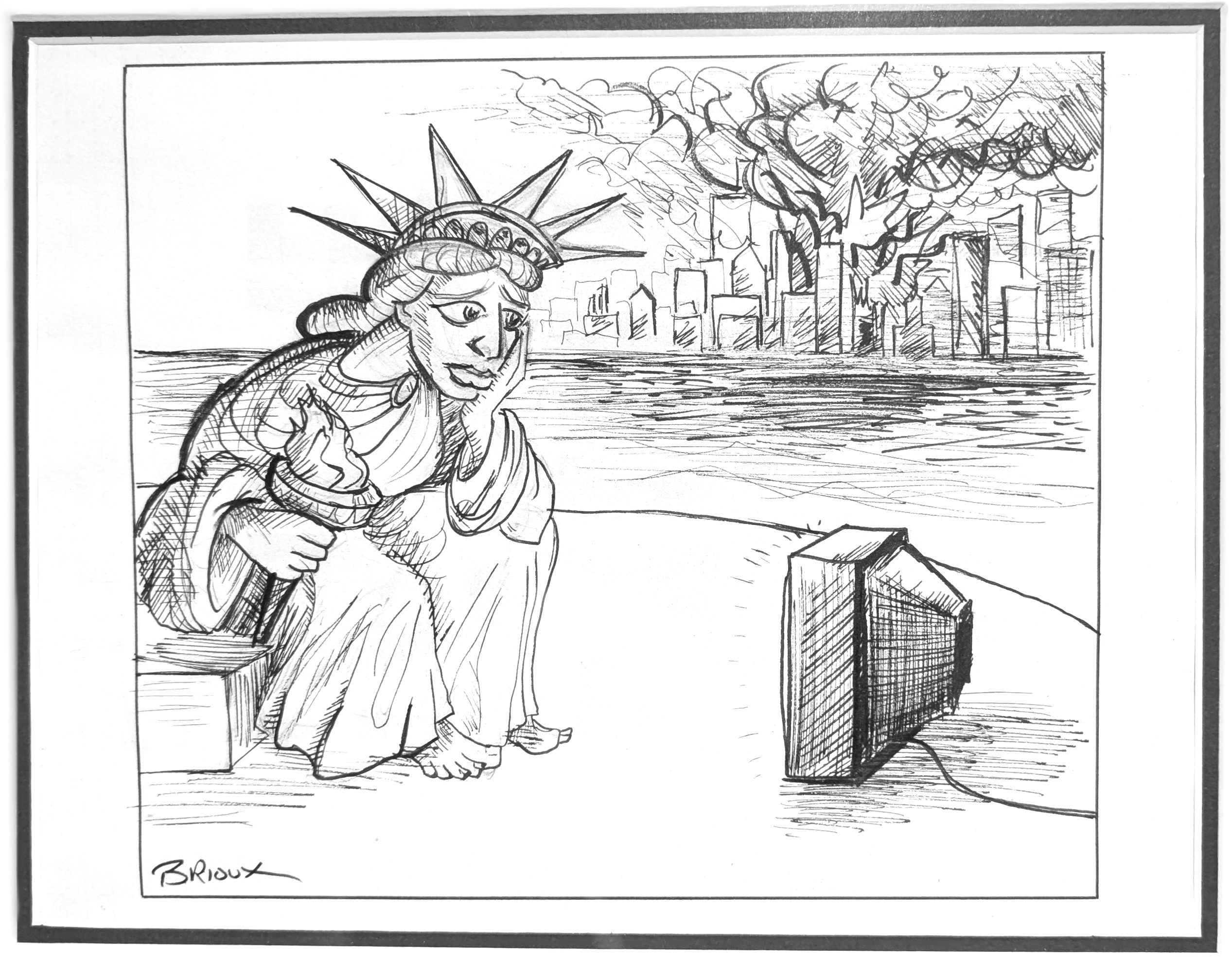
The biggest shock now about the September 11 attacks is that they happened 25 years ago. When I was barely a teen in 1970, it seemed unfathonable that World War II had ended just 25 years earlier. The world seems to be spinning at such an excellerated pace now, 25 years seem to have flown by in the blink of an eye. Is it because we have spent the past two decades on-line, in a constant state of information overload? Or is it just a product of being older?
Even this blog, which I began in 2007, is in its 19th year. My own world of reporting on television has been in a constant state of change. One advantage, however, is being able to search myself and find past posts on the anniversary of 9/11, right back to my own memories of covering the story live on that terrible day as the TV columnist at the Toronto Sun.
I was late arriving in for work, and had a long commute in to downtown Toronto, so I was following the story on the radio. By the time I arrived at 333 King Street East it was all hands on deck at the newspaper. The decision had been made to put out a “bulldog” edition that day (a special, afternoon edition), the first time in 25 years that the paper had hit the streets with anything other than a morning run.
Being the TV critic, I’d usually be getting out of the way during what was and still is the hard news story of the century. The entertainment section wasn’t called “the toy department” for nothing. But right from the beginning, television was the rest of the world’s window on the tragic events unfolding in New York, Washington and elsewhere. The horrifying images of the World Trade Center in flames was on every channel. There was no screen in your hand to follow along on that day; you had to be in front of a TV. That is where I sat and typed, trying to make sense out of so many frightening images.

The demands were instantaneous as well for the electronic press. Five years ago I wrote a story for The Toronto Star that ran in a special, ad-free section dedicated to the 20th anniversary of the attacks. My assignment was to round up prominant Canadian anchors who covered the story as it was breaking. One of my first calls was to the late Lloyd Robertson who told me he was woken up and told to get straight to the CTV newsroom. When he arrived, he stayed on the air for 14 hours straight. Peter Mansbridge and Kevin Newman, the latter then just days into his job as anchor of Global National, served similar iron man stints.
The guy I remember being so impressed with was another Canadian, ABC’s Peter Jennings. Besides his usual authoritative calmness, he just seemed so on his game, stopping to ask firefighters and emergency workers what he was not getting from the unfolding story. Jennings raised the level of coverage, always focused on being a reporter.
advertisement
The Fall 2001 TV season was just about to start, and the networks were struggling and scrambling in response to the attacks. Fox had this brand-new anti-terrorist drama called 24. The pilot featured the destruction of a commercial jet. Jack Bauer, played by Kiefer Sutherland, looked like he was going to get yanked off the air before his first bad day had even begun. Another CIA-themed adventure series, The Agency, was benched and quietly slipped off the radar. The WB had to postpone its lighter-than-air Friday premieres twice.
In Canada, 50 new digital specialty channels had launched just days before. If anybody needed Lonestar or Drive-In or the women’s sports channel before 9/11, they didn’t afterwards. Those digital channels never became the next great profit centre many in the industry had envisioned.
Award shows were canceled, postponed or, in some cases, muted. Gone was any red-carpet frivolity. Ellen DeGeneres earned respect for soldiering on as host of a very toned-down Emmy Awards. Several silly reality shows were derailed or canceled. Everything got very sombre and serious.
The guy who showed it was all right to go back on the air was David Letterman. In what may have been his greatest moment, Letterman opened his nightly talk show without the usual theme or visuals and went straight to the desk, delivering a heartfelt soliloquy about the “terrible sadness” in New York one week after the attacks. For 20 years an icon of irony and sarcasm, Letterman set a new tone of grace, dignity and courage.
This was, of course, years before everything in late night became intensely political.
Shortly after Letterman’s return to the air, tens of millions of dollars were raised for victims of 9/11 and their families in a live, candle-lit, star-studded musical special America: A Tribute to Heroes. It was a brief, shining moment of calmness and sanity, a movement away from the vulgarity of celebrity and toward the celebration of real individuals.
Then it all stopped. By the new year, it was The Osbournes, The Bachelor, Celebrity Boxing and Anna Nicole Smith. The distractions were back, and they were dumber than ever, or at least seemed that way then; who knew things would eventually get way, way dumber?